
API Holdings, the parent company of online pharmacy PharmEasy, has significantly reduced its debt from 1,800 crore to 1,050 crore and refinanced it at lower interest rates under CEO Rahul Guha, shifting its focus from 'growth at any cost' to profitability and aiming for a debt-free balance sheet before a potential stock market listing.

Inflation data, trading activity of foreign investors and global trends would dictate sentiment in the stock market this week, according to analysts.

Without doubt, bears have raided. We try to fathom what further damage could they cause, for how long and how to cope with it.

'If nominal growth improves and earnings pick up, Indian stock markets could see a rally next year.'

State-run Oil and Natural Gas Corporation (ONGC) has approved the development of a 1.75 million tonnes (mt) strategic petroleum reserve (SPR) in Mangaluru, a project deemed of national importance, with plans for broad commercial utilisation.

India's finance ministry anticipates inflation will remain relatively contained in the coming months, supported by a correction in crude oil prices and softening input costs following the cessation of the West Asia conflict, despite earlier spikes in wholesale and retail inflation.

A potential US-Iran peace deal, expected to be signed on June 19, is anticipated to ease geopolitical stress and benefit various sectors, particularly in India, with analysts suggesting investors await finer details before making significant moves.

Investors should do thorough due diligence when selecting a platform.
Graham's formula helps stock market investors identify if a stock is cheaper or not. Even successful investors are said to be using this formula devised by Benjamin Graham.
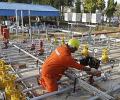
State-run oil-marketing companies (OMCs) are unlikely to significantly raise petrol and diesel prices despite crude oil nearing $100 a barrel, leading to potential margin pressure, while CLSA analysts project a 65 per cent upside for ONGC's stock.

While the markets have factored in a number close to 350 for the BJP and almost 400 for the NDA, 50 seats fewer could trigger a market correction

Indian benchmark equity indices, Sensex and Nifty, rebounded nearly 1 per cent, with the Sensex jumping 790.54 points to 76,991.22, driven by softening crude oil prices and strong buying in banking, financial, and IT shares.

Indian equity benchmark indices Sensex and Nifty closed lower on Thursday, driven by escalating tensions between the US and Iran, persistent foreign fund outflows, and concerns over rising US inflation.

The option chain offers a deeper insight into market sentiment, institutional positioning, and potential price movements. However, despite its advantages, many traders still underutilise it. We will explore why option chain data is most powerful and the reasons behind its underutilisation.

Indian companies are increasingly turning to share buybacks as a preferred payout strategy, driven by recent tax framework changes that make them more tax-efficient for non-promoter shareholders and a fall in stock prices.

India's manufacturing sector experienced a moderation in growth during June, with the HSBC India Manufacturing Purchasing Managers' Index (PMI) falling to 54.2 from 55.0 in May. This slowdown is attributed to softer increases in new business orders and international sales, leading to reduced expansions in buying levels, employment, and output.

Indian benchmark stock indices Sensex and Nifty rebounded nearly 1 per cent, snapping a three-day decline, driven by rallies in Reliance Industries and Sun Pharma, alongside positive global market trends and easing geopolitical tensions.

According to the report, the market continues to hold promise as the economy is expected to grow above five per cent even in the global economic downturn.

Indian equity benchmark indices Sensex and Nifty tumbled over 1 per cent for the third consecutive day, driven by a sharp rally in crude oil prices, massive selling in IT stocks, and unabated foreign fund outflows amid ongoing geopolitical tensions in the Middle East.
Indian benchmark indices, Sensex and Nifty, closed lower, primarily due to a sharp sell-off in IT stocks, a fresh surge in crude oil prices, and sustained outflows from foreign institutional investors. The Sensex dropped over 300 points, while the Nifty declined by 77.95 points.

Indian equities are experiencing their sharpest rebound in years, with the BSE 500 index rallying 12.1 per cent so far this month, echoing Covid-era recoveries despite ongoing geopolitical uncertainty and earnings risks.

'Given that India underperformed emerging markets by 28 per cent in 2025, the worst performance in over 30 years, the timing of the sharp STT hike could have been better.'

Fintech unicorn Razorpay has confidentially filed draft documents with SEBI for an Initial Public Offering, with market sources estimating the issue size between Rs 5,000-6,000 crore. This move comes as a rival firm, PhonePe, has paused its IPO plans.

Does the rally reflect expectations of improving fundamentals or they are likely to correct?

'The real money in India over the coming period is likely to be made in small-cap stocks rather than in the large-cap benchmark names.'

The Haryana government is taking strict action against black marketing of cooking gas cylinders, registering FIRs and seizing hundreds of cylinders to ensure adequate supply for citizens.

The Indian rupee weakened against the US dollar due to a strengthening dollar, high crude oil prices, and foreign fund outflows amid geopolitical uncertainties.

JPMorgan has downgraded Indian equities to 'neutral' from 'overweight', citing elevated valuations, rising earnings risks, and limited exposure to next-generation technology like AI. The brokerage believes other emerging markets offer more attractive risk/reward propositions despite India's strong structural growth story.
On the day Obama won, Indian markets reacted positively; even IT stocks gained. Will the trend continue?
My expectation is for the present downturn to last for between one and three months, says the investment guru.
The Haryana government is taking strict action against individuals involved in the black marketing of cooking gas cylinders, resulting in multiple FIRs and the seizure of hundreds of cylinders.

Take calculated, not blind risks, suggests Ramalingam K.
Indian equity benchmark indices, Sensex and Nifty, ended marginally lower in a volatile trading session, surrendering early gains due to profit-taking in blue-chip stocks and persistent macroeconomic concerns, despite positive global cues.

Despite initial pressure from the West Asia conflict, analysts are optimistic about the Indian hospital sector's outlook, citing strong demand drivers and ongoing expansion plans that are expected to fuel significant revenue growth over the next few years.

'The day that the market realises that they've overspent (on AI) and there's a sudden collapse in the capex, then India can start outperforming again.'
Market stalwarts believe that the Indian growth story remains intact.

India's top 16 IT services companies distributed a record 1.3 trillion to shareholders in FY26 through dividends and share buybacks, a 36.3 per cent increase from FY25, even as the industry grappled with AI-driven business model threats and a significant decline in market capitalisation.

Total foreign investment in the stock market has reached Rs 90,715 crore so far in 2013.
The Haryana government is taking strict measures to combat the black marketing of cooking gas cylinders, registering FIRs and seizing hundreds of cylinders. Officials assure citizens of sufficient LPG supply despite global concerns.
